


When it comes to fluid transfer systems, Banjo Elbow Stainless plays a crucial role. As a dedicated supplier of Banjo Elbow Stainless, I am often asked about the bend angle of these essential components. In this blog, I will delve into the typical bend angles of Banjo Elbow Stainless, their significance, and how they fit into various applications.
Understanding Banjo Elbow Stainless
Before we explore the bend angle, let's briefly understand what a Banjo Elbow Stainless is. A Banjo Elbow Stainless is a type of stainless - steel fitting used in fluid transfer systems. It is designed to connect pipes or hoses at an angle, allowing for a change in the direction of the fluid flow. The "banjo" part of its name comes from its unique shape, which resembles a banjo. These fittings are known for their durability, corrosion resistance, and ability to withstand high pressures, making them ideal for a wide range of industries, including automotive, industrial manufacturing, and food processing.
You can find a comprehensive range of Banjo Elbow Stainless on our website, where we offer different sizes and configurations to meet diverse customer needs.
Typical Bend Angles
The most common bend angles for Banjo Elbow Stainless are 45 degrees and 90 degrees. These angles are widely used because they provide practical solutions for many fluid transfer scenarios.
45 - Degree Bend Angle
A 45 - degree bend angle in a Banjo Elbow Stainless offers a moderate change in the direction of the fluid flow. This angle is useful when you need to make a slight adjustment to the flow path without making a sharp turn. For example, in automotive fuel lines, a 45 - degree Banjo Elbow Stainless can be used to route the fuel line around engine components while maintaining a relatively smooth flow. It also helps in reducing the stress on the pipes or hoses connected to the fitting, as the less - sharp angle results in less turbulence in the fluid flow.
In industrial settings, such as hydraulic systems, a 45 - degree bend can be used to connect pipes in areas where space is limited, and a 90 - degree turn would be too obstructive. This angle allows for a more flexible installation, enabling the hydraulic lines to be routed efficiently around machinery and equipment.
90 - Degree Bend Angle
The 90 - degree bend angle is perhaps the most well - known and widely used in Banjo Elbow Stainless. It provides a sharp change in the direction of the fluid flow, which is essential in many applications. In plumbing systems, for instance, a 90 - degree Banjo Elbow Stainless is commonly used to connect pipes at right angles, such as when changing the direction of a water supply line from a vertical to a horizontal orientation.
In chemical processing plants, 90 - degree Banjo Elbow Stainless fittings are used to direct the flow of chemicals through different sections of the processing equipment. The sharp turn can be precisely engineered to control the flow rate and pressure within the system. Additionally, in pneumatic systems, a 90 - degree bend is often required to route the compressed air lines around corners and obstacles in the factory layout.
Other Bend Angles
While 45 and 90 degrees are the most common, Banjo Elbow Stainless can also be manufactured with other bend angles to meet specific customer requirements. For example, 30 - degree and 60 - degree bend angles are sometimes used in applications where a more gradual or intermediate change in the flow direction is needed. These non - standard angles can be custom - made based on the unique design of a fluid transfer system.
Significance of Bend Angle
The bend angle of a Banjo Elbow Stainless has several important implications for the performance of a fluid transfer system.
Flow Efficiency
The bend angle affects the flow efficiency of the fluid within the system. A sharp bend, such as a 90 - degree angle, can cause more turbulence in the fluid flow compared to a more gradual bend like a 45 - degree angle. Turbulence can lead to increased pressure drop, which means more energy is required to maintain the desired flow rate. Therefore, when designing a fluid transfer system, it is important to choose the appropriate bend angle to minimize pressure drop and improve overall flow efficiency.
Stress on Components
The bend angle also impacts the stress placed on the pipes, hoses, and the Banjo Elbow Stainless itself. A sharp bend can create higher stress concentrations at the connection points, potentially leading to premature wear and failure of the components. By selecting the right bend angle, the stress can be distributed more evenly, reducing the risk of leaks and extending the lifespan of the system.

Installation Flexibility
The availability of different bend angles provides greater installation flexibility. In complex industrial or automotive systems, where space is often limited and there are multiple components to work around, having a variety of bend angles allows for a more customized and efficient installation. This flexibility can save time and cost during the installation process.
Compatibility with Other Fittings
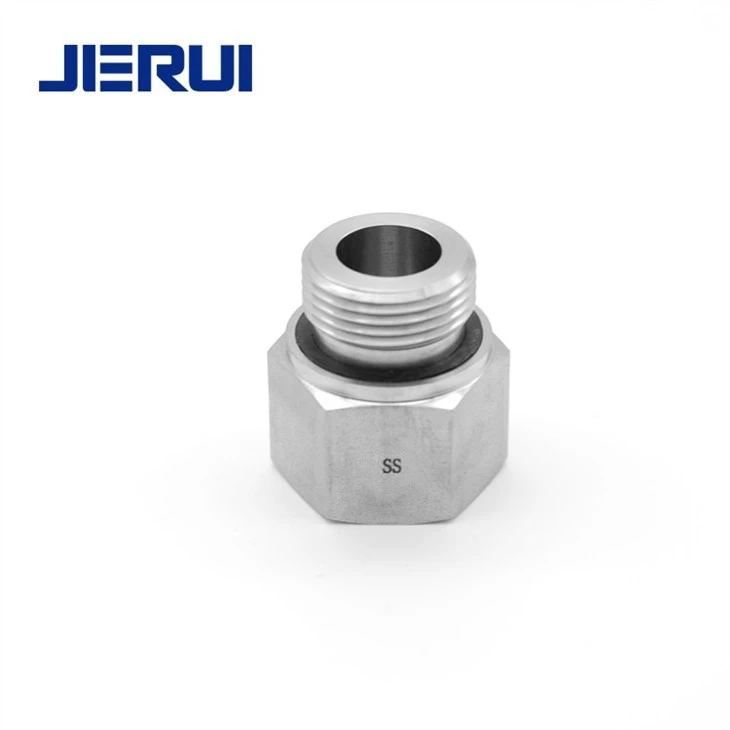
Banjo Elbow Stainless fittings are often used in conjunction with other stainless - steel fittings, such as Reducer Stud Coupling Stainless and Plug Stainless. The bend angle of the Banjo Elbow Stainless needs to be considered in relation to these other fittings to ensure a proper and leak - free connection.
For example, when using a Banjo Elbow Stainless with a Reducer Stud Coupling Stainless, the bend angle should be such that it allows for easy alignment and connection of the two fittings. Similarly, when a Plug Stainless is used to close off a branch in the fluid transfer system, the bend angle of the adjacent Banjo Elbow Stainless should not interfere with the installation or removal of the plug.
Conclusion
In conclusion, the typical bend angles of Banjo Elbow Stainless, namely 45 degrees and 90 degrees, offer practical solutions for a wide range of fluid transfer applications. However, other bend angles can also be customized to meet specific needs. The choice of bend angle is crucial for ensuring flow efficiency, reducing stress on components, and providing installation flexibility.
If you are in need of high - quality Banjo Elbow Stainless or other stainless - steel fittings for your fluid transfer system, we are here to help. Our team of experts can assist you in selecting the right bend angle and fitting configuration for your specific requirements. Contact us to start a procurement discussion and find the best solutions for your project.
References
- Fluid Mechanics textbooks, which cover the principles of fluid flow in pipes and fittings.
- Industry standards and guidelines for stainless - steel fittings in various sectors such as automotive, industrial, and plumbing.