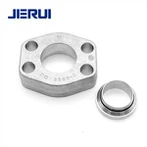
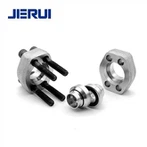
In hydraulic industry, hydraulic pipeline installation is one of the important projects of hydraulic equipment installation. Pipeline installation will directly affect the performance of hydraulic system and the service life of hydraulic system.
In the hydraulic pipe distribution design and piping, should first according to the hydraulic schematic diagram, the required connection of the components, hydraulic components, pipe joints, flanges for a comprehensive consideration. The design, arrangement and direction of the pipeline should be neat and consistent, with distinct layers. Try to use horizontal or vertical pipe distribution, horizontal pipe should not exceed 2/1000 degree of parallelism; Vertical pipe perpendicularity should not exceed 2/400, the department with a level test, to be adjusted.
A gap of more than 10mm shall be left between crossed or parallel pipe systems. They must be configured so that pipes, hydraulic valves and other components can be loaded and unloaded and maintained easily. It should be possible for any section of pipe or component in the system to be freely disassembled without affecting other components.
Hydraulic equipment for piping, must make the pipe has a certain rigidity and vibration resistance. Pipe brackets and clamps shall be provided appropriately. A bracket or pipe clamp shall be installed near the bending point of the bent pipe. Pipe shall not be welded directly with bracket or pipe clamp. The weight of the pipe should not be borne by the valve, pump and other hydraulic components and accessories. Heavier component weights should not be supported by pipes. For longer pipes, effective measures must be considered to prevent the stress caused by the expansion of the pipe due to temperature changes.
The pipe material used for hydraulic equipment must have clear and reliable original material proof, for the pipe material unknown prohibited use. Pipe diameter less than 50mm can be cut by grinding wheel cutter. The pipe with diameter of more than 50mm should be cut by mechanical machining. Such as gas cutting. Except for the return pipe, the pressure from the pipe is not allowed to be cut with the roller type extrusion cutter. Pipe cutting surface must be smooth, remove burr, oxide skin, slag, etc. The incision surface should be perpendicular to the pipe axis.
If each complete pipe consists of multiple pipe sections and fittings, take over the pipes one by one. After the completion of a section, assembly, and then configuration of the next section, to avoid the cumulative error after a welding. In order to reduce local pressure loss, the section of the pipeline should avoid local sharp expansion or contraction of the section and sharp bending.
In the piping system, the pipe connected with the pipe joint or flange must be a straight pipe, that is, the axis line of the pipe should be parallel to the axis of the pipe joint and the flange. The length of this straight line segment must be greater than or equal to 2 times the pipe diameter. Pipe with outer diameter less than 30mm can use cold bending method. The outside diameter of the pipe can be used in 30 ~ 50mm cold bending or hot bending method. When the outer diameter of the pipe is greater than 50mm, the hot bending method is generally adopted.
Note: Welders welding hydraulic pipe should hold valid high pressure pipe welding certificate. Hydraulic pipe welding process selection: acetylene gas welding is mainly used for general carbon steel pipe wall thickness is less than or equal to 2mm pipe. Arc welding is mainly used for carbon steel pipe with wall thickness greater than 2mm. The pipes are best welded by argon arc welding. For pipes with wall thickness greater than 5mm, argon arc welding should be used as the bottom, and arc welding should be used to fill. If necessary, the method of filling the hole with protective gas should be used for welding. The welding rod and flux should be matched with the welded pipe, and the grade must have clear basis data, product qualification certificate, and within the effective service period. Before use, it should be dried according to the product instructions, and keep dry during use, and use on the same day. Electrode coating shall be free of peeling and significant cracks. Hydraulic pipe welding should be butt welding. Before welding, clean the dirt, oil, water and rust on the surface of the groove and its vicinity 10 ~ 20mm wide.
Welding pipe and flange should adopt butt welding flange type, not insert flange type. 20, pipe and pipe welding should be butt welding, not allowed to use insert welding form. When the hydraulic pipe adopts butt welding, the inner wall of the weld must be 0.3 ~ 0.5mm higher than the pipe. Concave into the inner wall is not allowed. After welding, use file or hand-held grinding wheel to smooth the high weld in the inner wall. Remove welding slag, burr, to achieve a smooth degree. The cross section of the butt weld shall be perpendicular to the center line of the pipe. The weld section is not allowed at the corner and should be avoided between the two bends of the pipe. When welding pipe, spot welding must be performed according to the installation position, then remove and weld the pipe, and then assemble and shape the pipe. During the whole welding process, the invasion of wind, rain and snow should be prevented. After welding, welding seams with wall thickness less than or equal to 5mm should be cooled naturally at room temperature, and no strong wind or water should be used to force cooling. The weld should be welded through and the appearance should be uniform and smooth. Weld seams of pressure pipes should be sampled for inspection. After piping is welded, all pipes shall be preinstalled once according to their location. Connect each hydraulic component, valve block, valve frame and pump station. All interfaces should be connected and aligned naturally, and cannot be twisted. When loosening the pipe joint or flange screw, there shall be no large dislocation, unseam or offset Angle relative to the center line of the joint surface. If this happens, it can be cured by fire. The pipe clamp can be welded firmly to the frame after all piping is completed, or it can be crossed as required.
After piping, welding and pre-installation, the hydraulic pipeline is disassembled again for pickling phosphating. After pickling phosphating pipeline, hot air is passed into the pipeline for rapid drying. After drying, if it is reinstalled into the system in a few days and hydraulic oil is inserted into the pipe, it may not be treated as rust prevention, but it should be kept properly. If it is necessary to use for a long time, rust proof coating is needed, it must be applied after 48 hours of phosphating treatment. It should be noted that the antirust coating must be compatible with the cleaning fluid or hydraulic fluid used in future pipeline cleaning. Before the pipe is installed again after pickling, phosphating and drying, it is necessary to carry out a pre-cleaning on the inner wall of each pipe. After the pre-cleaning is completed, the system should be reinstalled as soon as possible to carry out the overall cycle purification treatment of the system until it reaches the cleanliness level required by the system design.
The application of the hose in the hydraulic system is limited to the following occasions:
between the movable components of the equipment
convenient replacement parts
Inhibit the transmission of mechanical vibration or noise
The installation of the hose must pay attention to the hose and joint do not cause additional force, distortion, sharp bending, friction and other bad working conditions. Before loading the hose into the system, the inner cavity and joint should also be cleaned.