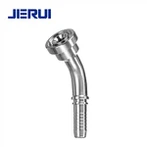
Precautions for hydraulic pipeline installation:
steel pipe
Hydraulic pipeline installation according to the system technical parameters (working pressure, working flow) selected pipe material, wall thickness, diameter. See pages P17-615~616 of Volume 4 of the Mechanical Design Manual.
Select the joint form. See the Mechanical Design Manual Volume 4 pp. P17-617~618.
The pipe is beautiful, smooth and non-interference. For the pipe on the equipment, it should be arranged along the equipment as far as possible to form a whole with the equipment.
The pipe has to be horizontal and vertical. That's the benchmark for the pipe.
Pipes are not allowed to be welded directly with pipes, each pipe should have pipe joints at both ends, in order to clean welding slag, pickling tank pickling, transportation.
The pipe between the two interfaces, do not design straight, easy to leak.
Pipe and joint should be vertical, if not straight, to straight, there is a stage bend in the middle of the transition. Otherwise, it is easy to leak oil.
Pipe turning should avoid sharp bends as far as possible. Small diameter pipe can be directly bent into pipe, and large diameter pipe should use flow shaped elbow.
Pipe diameter change, to have a transition joint.
Pipe and joint welding, to open the groove.
Welding requirements are argon arc welding, at least argon arc welding as the base.
The hose is generally used in the equipment has vibration and the two interfaces have relative motion. Requirements refer to the Mechanical Design Manual, Volume 4, page P17-772~774.
Hose torsion should be avoided as much as possible.
Avoid external damage.
Reduce bending stress. In the total range of motion does not exceed the allowable minimum radius, at the same time, does not bear tensile stress. Bend radius 9-10 times outer diameter of hose.
Install accessories to guide and protect.
The pipe shall be fixed with pipe clamp, and the spacing shall be as specified in the design manual. See Mechanical Design Manual Vol. 4 pp. P17-774.2.
There should be a pipe clamp near the pipe joint.
Pipe clamps should be placed at both ends of the bend instead of within the radius of the bend. Otherwise, the tube has no room for deformation.
Design double-layer pipes and use double-layer pipe clamps when running pipe ditches; If a suitable double-layer pipe clamp cannot be selected, use a single-layer pipe clamp. The bracket cannot be fixed on both sides of the trench wall. Only cantilever type can be used. Or, fix it directly to the trench wall.
The foundation of the fixed pipe clamp must be rigid, otherwise, it is easy to produce vibration, and even damage the pipe fittings in serious cases. For example, the working pressure of hydraulic explosion-proof winch reaches 31.5Mpa. Because the support fixing the pipe clamp is directly fixed on the ground and the side is suspended, the system vibration leads to the pipe cracking.