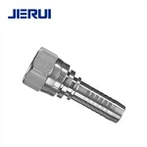
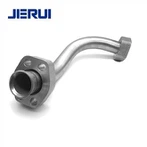
In the field of hydraulic fluid connectors, the 37° flare flange is a widely used standard component, and its angle setting is no accident.
Technically, the 37° angle enables optimal sealing surface fitting, effectively disperses stress under high-pressure conditions, and reduces leakage risks. Meanwhile, this angle complies with the mainstream JIC (Joint Industry Council) standard, balancing machining precision and assembly efficiency, and has become a universal choice for hydraulic systems.
Beyond 37°, the common flare flange also includes the 45° specification, which is mostly used for low-pressure pipelines or non-standard requirements in specific industries. Its sealing structure is simpler, but the pressure resistance is weaker than that of the 37° model.
Besides flare flanges, there are various flange types in industrial applications: Welded flanges are fixed by welds and suitable for high-temperature and high-pressure scenarios; Threaded flanges require no welding, feature easy installation and disassembly, and are ideal for pipelines transporting corrosive media; Blind flanges are used to seal pipeline ends and ensure system safety.
Each type of flange has its own advantages. The core of selection lies in matching working pressure, medium characteristics and installation requirements.