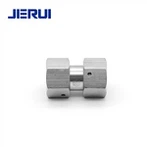
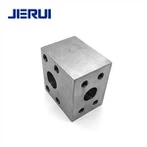
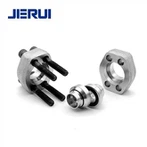
Not all fittings are the same!
This law is especially applicable to stainless steel pipe joints and connectors, which have the highest guarantee of safety and minimal failure.
The core component of the single sleeve joint manufactured according to EN ISO 8344-1 (DIN 2353) is the sleeve. In most cases a specially developed, precision-built and highly reliable double-edged single jacket is used, which is tested by Germanischer Lloyd. Single jacket seals three important parts of the installed joint.
Important advantages of 24° cutting ring fitting:
Very high penetration
High sealing performance, no rust on the surface
Reliable installation
Single sleeve does not require special placement
As the nut is tightened, the single jacket is squeezed into the cone. Under the action of the nut, the inner edge of the cone guide single jacket cuts into the surface of the steel tube. The end face of the inner edge forms a annular projection. The steel tube is squeezed inside the joint and sealed by proper, clean pre-installation. On the other side, the single sleeve bites the steel tube by squeezing the nut. There is an additional clamping force at this position of extrusion under dynamic load. If the tube is sawed vertically and cleanly deburred, the three important parts of the installed joint can be sealed.
S heavy series: suitable for heavy machinery under strong water hammer, vibration and high mechanical performance requirements. Shipbuilding, mining, chemical industry, large cooling equipment, port and lock equipment, offshore platforms, petrochemical, generally within the pressure range of PN 250-400, also up to PN 630.