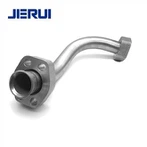
Structural features: When assembling a joint with advanced geometric design features (as shown on the left), the front sleeve is pushed into the joint body and the sleeve to form the main seal, and the sleeve is hinged inward to form a strong grip on the sleeve. The geometry of the rear jacket facilitates advanced engineering hinge-clamp action that translates axial motion into radial compression on the sleeve.

Double sleeves separate the sealing function from the grip function of the sleeve, and each sleeve is optimized for its corresponding function.
The front sleeve is used to form a seal:
The seal between the joint body, the seal of the outer diameter of the sleeve. When rotating the nut, the back sleeve will along the axial advance of the front sleeve along the radial application of an effective clamping sleeve.
Excellent gas seal and clamping action
Easy to install correctly
Excellent vibration fatigue resistance and clamping support
4.1 Ensure that all parts are clean and free from contamination during the whole assembly process.
4.2. Treatment of pipes:
4.2.1 The part of the pipe surface where the adapter is inserted shall be smooth and intact to avoid scratches and other defects.
4.2.2 The end face of the pipe shall be perpendicular to the axis of the pipe, and the pipe mouth shall be free from burrs.
4.2.3 If the pipe is to be bent, a certain length should be reserved at the end of the pipe, as shown in Figure 3. The value of L should follow the recommended value given by the joint manufacturer. Generally, the length of L should not be less than 3 times the length of the nut, otherwise the insertion and sealing of the pipe will be affected.